

In 2026, the decoration of a design hotel is no longer just about “looking good”: it must bring life. The most desirable projects are those that build an emotional and artistic experience — a journey that can be told, photographed, shared… and above all relives itself (customer feedback, loyalty). Recent analysis of hospitality trends in 2026 converges on this idea: travelers are looking for intentional, singular, grounded, and memorable experiences.
In this article, you will find:
- concrete 2026 trends (with applications by area: façade, hallway, corridors, bedrooms),
- a method for turning these trends into a concept,
- ready-to-copy checklists (brief/specifications),
- a natural language FAQ,
- and links to your 3 universes:
- www.metamorphoze.art (360° vision: concept, furniture, wall decorations, frescoes)
- www.signaletique.art (wayfinding & signage design)
- vitrophanie.art (privacy, light, identity on windows)
Definition: “design hotel in 2026”, what does it mean?
A design hotel in 2026 is a hotel that:
- offers a strong identity (we remember the place, not just the room),
- offers a fluid journey (you don’t get lost, you understand intuitively),
- creates a sensory atmosphere (materials, light, acoustics , colour),
- makes the experience photogenic without falling into the “gimmick” décor.
Hospitality design actors describe an evolution: attention is shifting “from look” to intentional experience and authenticity (hyper-localization, emotion, resilience, well-being).
The 10 major decoration trends for a design hotel in 2026
1) The immersive artistic experience becomes a “product” of the hotel
In 2026, art is no longer a decorative supplement: it is a driver of attractiveness. Hospitality analyses highlight that collections/works are increasingly integrated into the narrative of hotels, and are becoming an explicit part of the experience.
How to apply it (very concrete version)
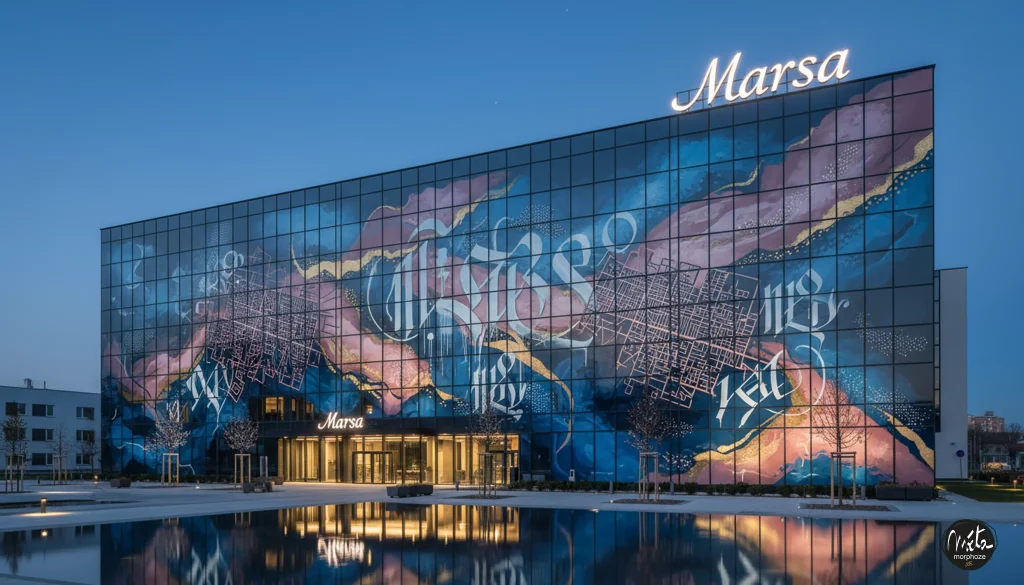
- Facade : monumental fresco or architectural composition (urban landmark + “photo moment” upon arrival).
- Hall : immersive “signature” work (1 strong piece rather than 10 small ones).
- Circulations : narration in sequences (like a storyboard): corridors, landings, stairwells.
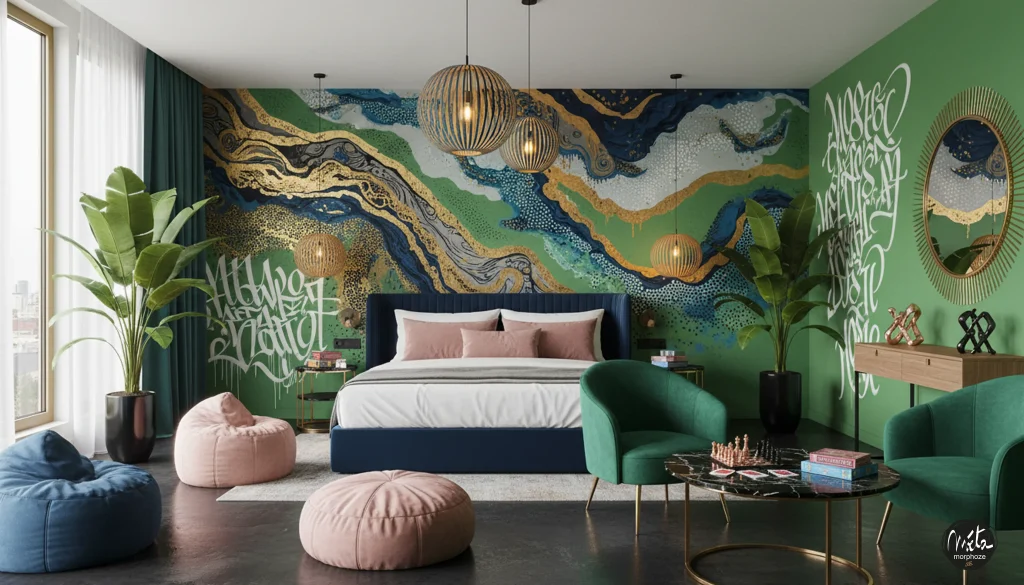
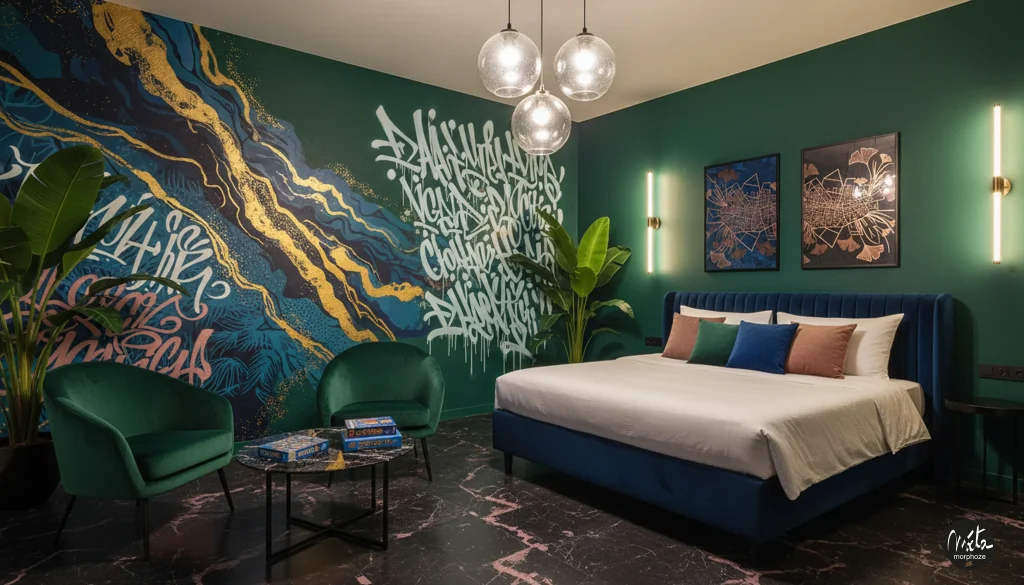
- Rooms : single headboard, fresco in an alcove, or localized mural (more intimate, more memorable).
➡️ Métamorphoze writes it in black and white on its hotel page: monumental fresco, façade, hall, corridor, spa, bedroom, headboard, etc.
Discover: Decoration hotel, restaurant, residence
Why it works in 2026
Because the experience becomes “shareable”: we photograph an emotion, not a sofa. And the 2026 trends insist on intentional and surprising experiences.
2) The “return to the human”: portraits, gestures, sensitive narratives
You put it very well: 2026 brings a strong trend towards human representation, humanity. In the hotel industry, this translates into:
- figures (faces, silhouettes, hands),
- stylized scenes of life,
- local histories (trades, territory, memory).
This trend connects to the quest for authenticity and storytelling (the hotel becomes a place that “has something to say”).
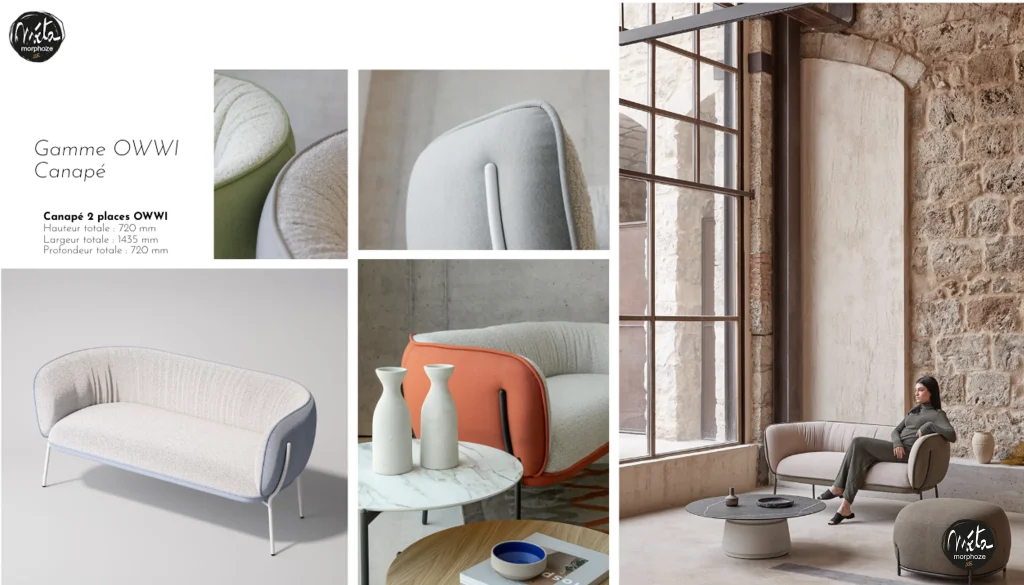
Where to use it
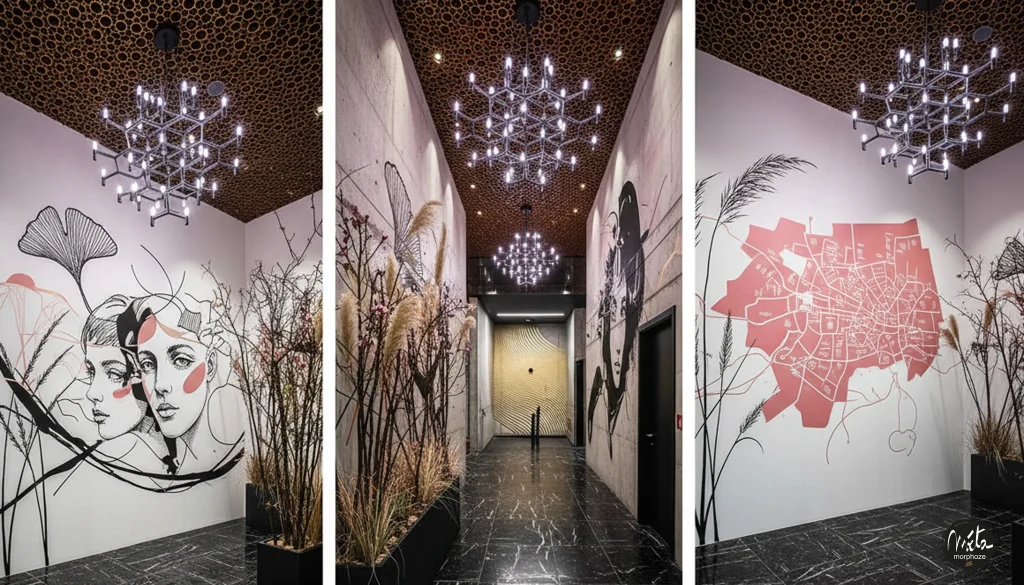
- Hall : large-format portraits (“human” welcome)
- Corridors : a narrative gallery (from subtle to monumental)
- Bedrooms : a signed headboard, with a stylized figure or a poetic scene
➡️ To inspire an “art + journey + experience” approach, see:
Concept, journey & multisensory experience
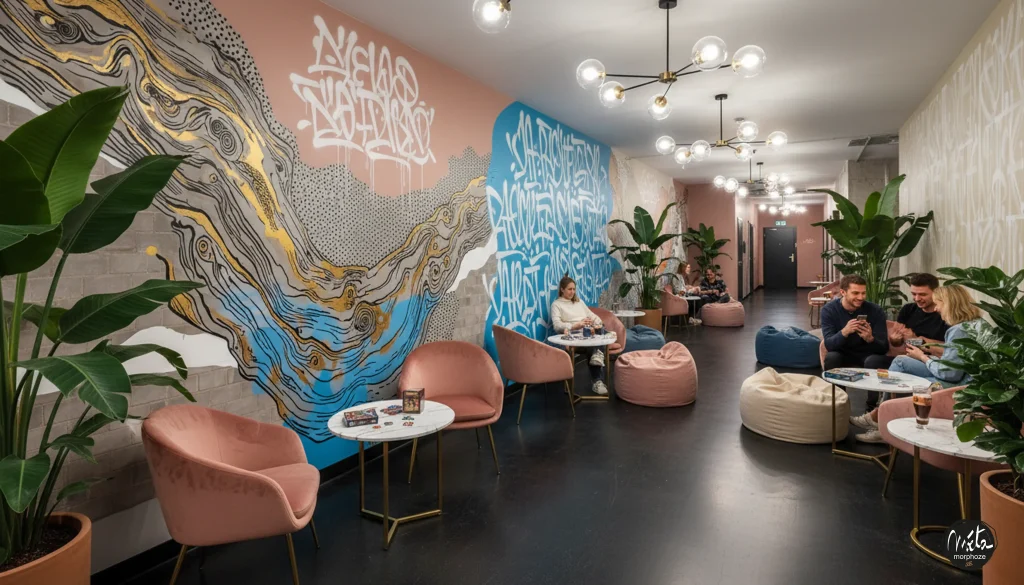
3) Humanity + plants: biophilia, herbaria, frames, “living” frescoes
Biophilia remains a pillar: nature, plants, organic patterns, natural materials. The 2026 trends (hospitality and commercial) continue to highlight plants, patterns inspired by nature, and the calming effect in common areas.
Your “signature” version (very 2026)
- Human mixed with plants : portraits + leaves, hands + flowering, scenes + botanical frames.
- Plant frames : fresco “framed” by foliage motifs (or woodwork / graphic mouldings).
- Monumental herbarium : corridor transformed into a graphic “garden”.
➡️ An example consistent with this direction: “Gourmet and vegetal / floral Rome” (hotel décor concept), already present in Métamorphoze’s projects.
See: Restaurant/bar decoration concept of a prestigious hotel
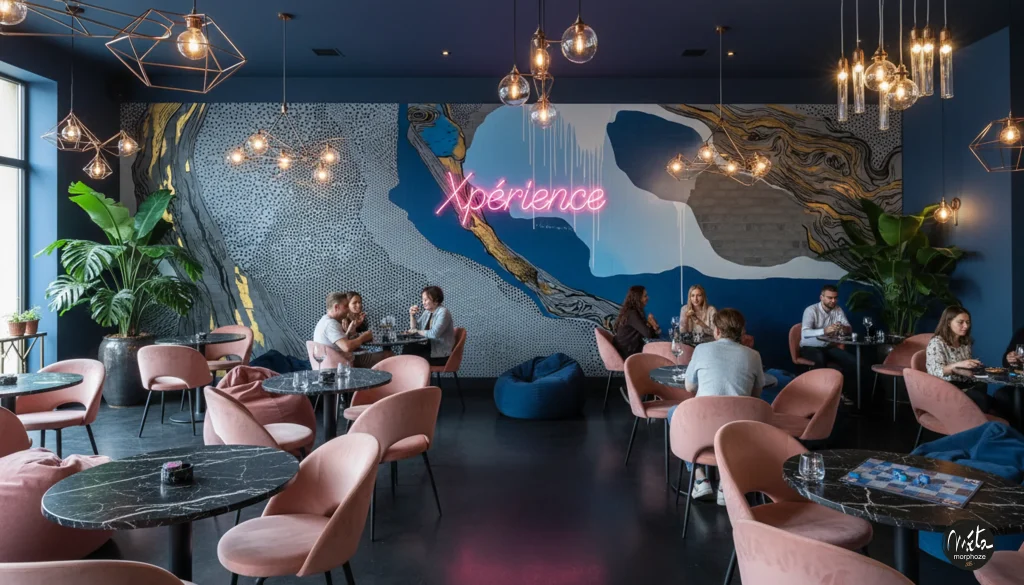
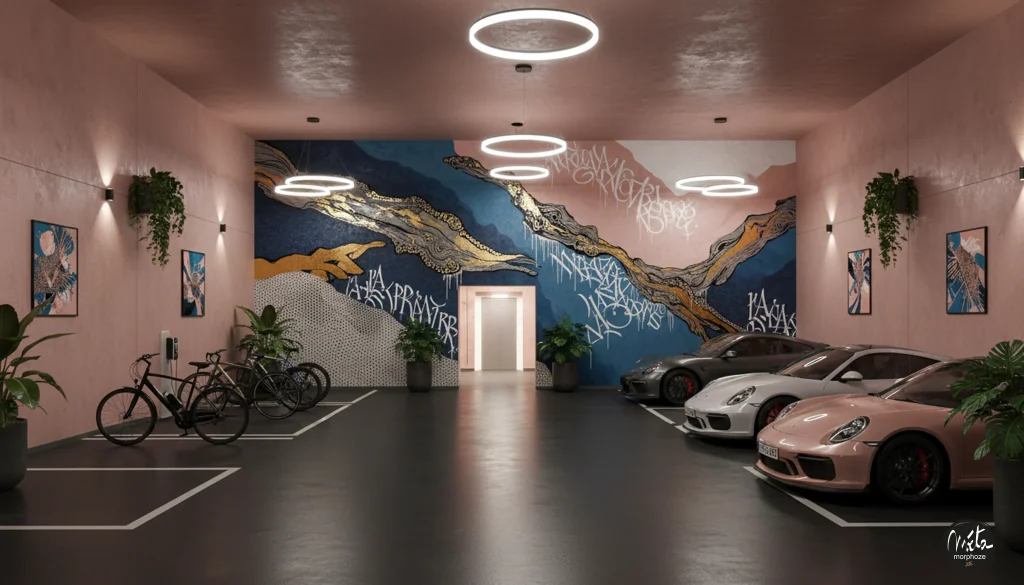
4) Soothing colors and “calm luxury” atmospheres
This is very much in line with the 2026 “restorative atmosphere” movement (well-being, calm, enveloping). We also see trends towards more sober, natural, “monastic” interiors (raw materials, chalky shades, feeling of retirement).
How to Choose a Soothing Palette (Without Being Bland)
- Base: mineral tones (stone, sand, soft terracotta, greyish greens)
- Accents: “Signature” colors (a brick red, a deep green, an ink blue) but in controlled touches
- Rule: Prioritize texture over saturation everywhere
👉 The 2026 designers and the famous painter Franck Blériot talk a lot about warmth, personality and authenticity, beyond “clinical” minimalism.
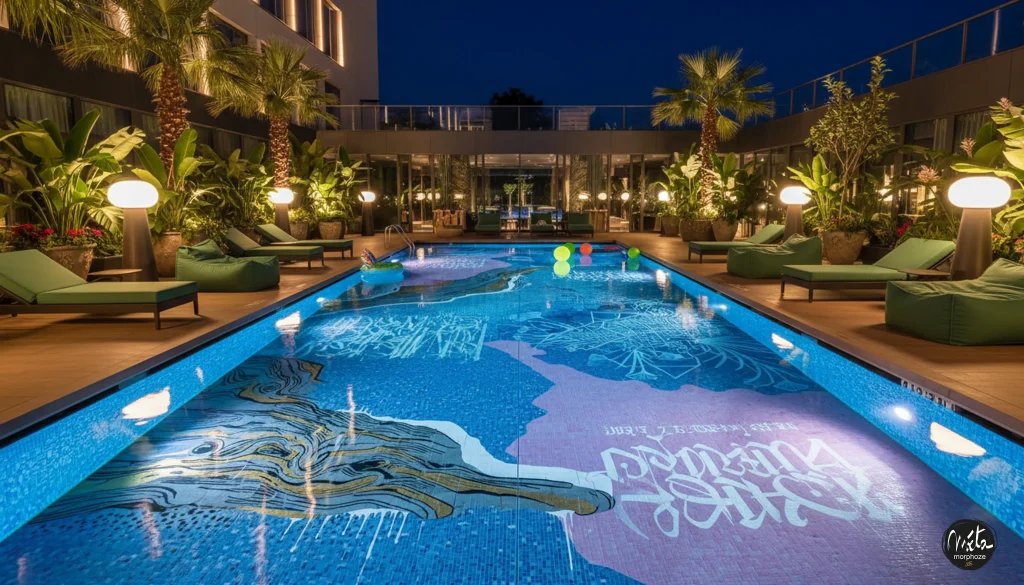
5) Tactile and craftsmanship: materials, patinas, reliefs, gestures
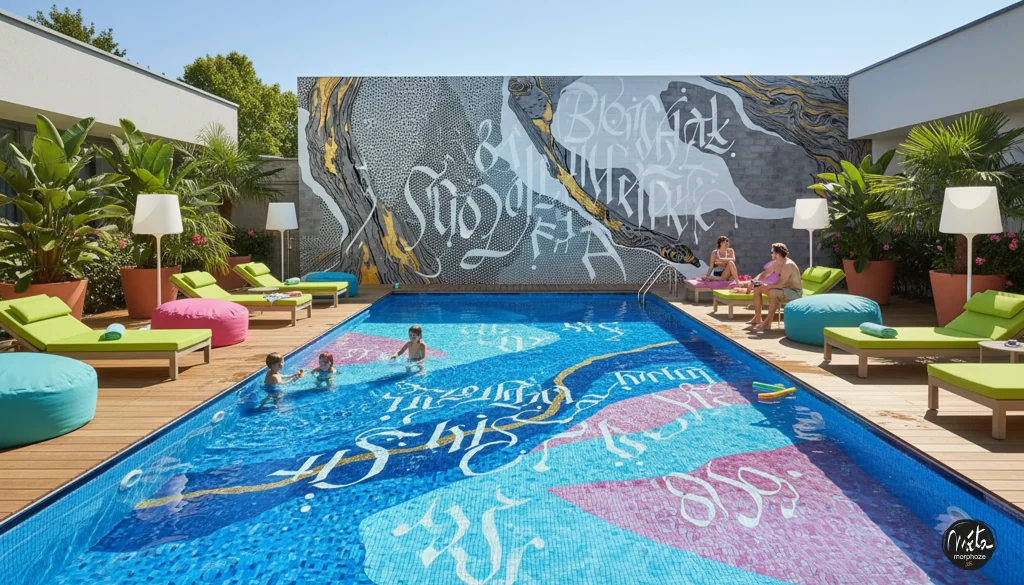
The luxury of 2026 can be read in the touch : fabrics, coatings, wood, stone, patinated metals, reliefs, superimposition of materials. Many 2026 trends (including on the consumer side) talk about craft, textures, finishes that age well.
Applications
- walls: “material” plasters, reliefs, effect paints
- Furniture: wood, patinated metal, engineered stone, thick fabrics
- Wall art: combining flat tints, lines, textures and details
➡️ At Métamorphoze, the “manufacturing / materials” dimension is structured around the factory (paints, cutting, large format printing, professional adhesives).
See: Factory & artisanal manufacturing
6) The bedroom becomes a “sanctuary”: unique headboard + in-room art
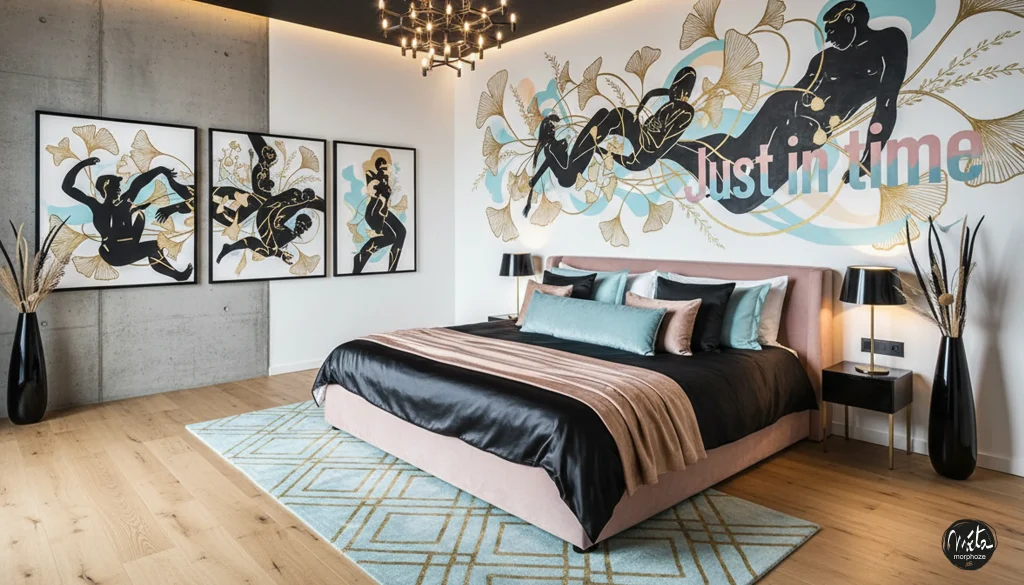
In 2026, the bedroom (especially boutique/luxury) is designed as a place of recuperation: cocooning, sleeping, calm, enveloping.
And the unique headboard (wall work or textile/graphic composition), a real strategic tool.
Why the headboard is a “ROI location”
- this is the first “bedroom” photo (Instagram, booking, reviews)
- it is an immediate marker of singularity
- It’s a perfect format for custom art
➡️ On its hotel page, Métamorphoze explicitly cites the intervention “on a headboard” as a natural terrain for wall design.
See: Hotel decoration
7) Circulations are no longer “corridors”: they become an emotional journey
The most frequented hotels will be those that make you feel the emotions in a big way : it’s not just the room, it’s everything you go through. This logic of journeys (moments, surprises, landmarks) is exactly what the 2026 hospitality trends describe: intentional, memorable, personalized experience.
Applications
- “Gallery” in the corridor (scenes, portraits, plants, frames)
- “Chapters” by floor (palette + pattern + pictograms)
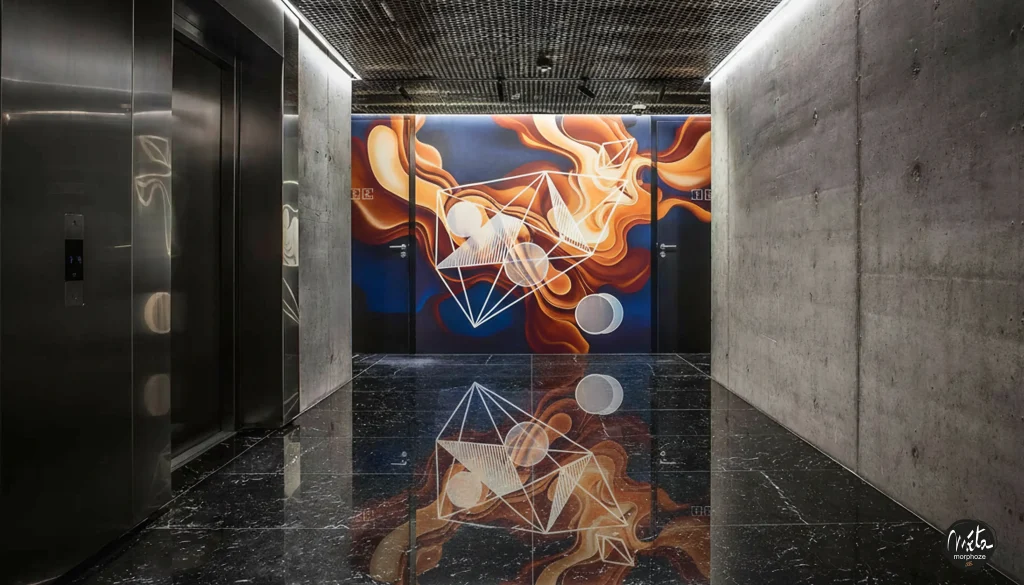
- elevator landings as micro-events
➡️ To see how Métamorphoze thinks about “journey & experience”:
Concept, journey & experience
8) Signage becomes “sensory” because it is integrated (and beautiful)
In 2026, successful signage is signage that is not noticed as a separate object: it is integrated into the décor, consistent with the place, and yet perfectly legible.
Key trend: “wayfinding design”
- Less text
- More hierarchy
- Color Codes
- Pictograms
- Premium Materials
- Consistency with identity
This is exactly the direction of modern design signage: to guide and reassure, while strengthening the brand. For a dedicated centre: www.signaletique.art
When the fresco serves as a landmark (“green floor”, “corridor of figures”), the signage becomes simpler and more beautiful.
➡️ Example of décor + signage logic in a hotel/SPA context:
Signage & design window displays – Hotel Neptune
9) Window stickers create a subtle atmosphere
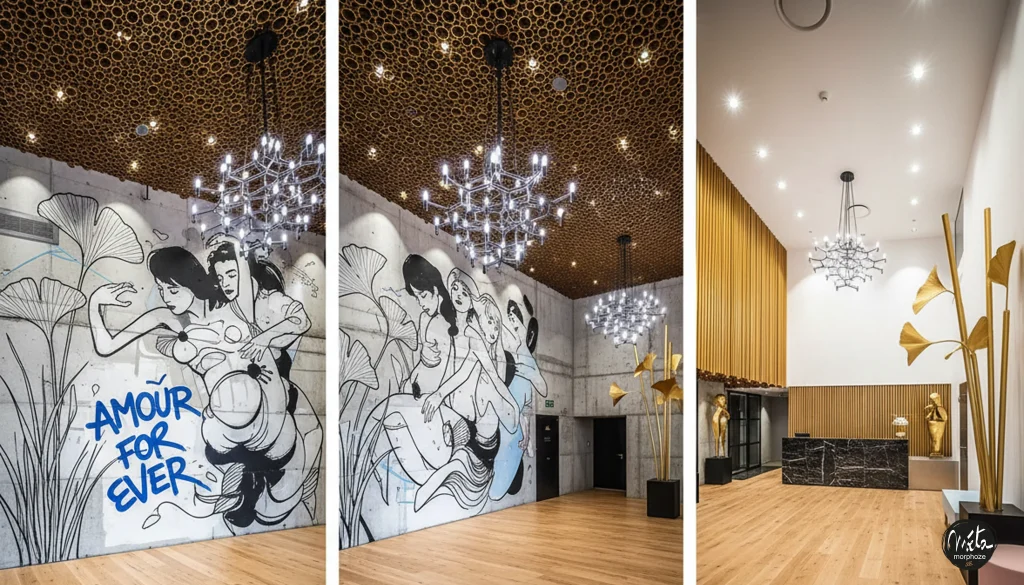
The modern hotel industry is full of glazing: spa, gym, seminar rooms, glass roofs, glass doors. In 2026, window stickers are used to:
- privacy (without losing the light),
- safety glazing (discreet markings),
- graphic continuity (patterns, wefts, room numbers).
➡️ Dedicated division: vitrophanie.art
And on the Metamorphosis side, the window sticker is explicitly presented as an extension of the mural art.
Advice from Franck Blériot : “The window sticker is the discreet tool that topples a place: confidentiality respected, light preserved, and aesthetic coherence.”
10) The “destination” lobby: third place, community, and scenography
The lobby is no longer just a check-in: it’s a space where you stay, where you consume, where you post. The 2026 trends insist on intentional, surprising, sometimes hybrid spaces (social + calm + experience).
Applications
- A signature work behind the desk (photogenic but not kitsch)
- An immersive fresco that creates a “moment”
- Integrated signage (avoiding confusion)
- A window that filters and sublimates
➡️ Métamorphoze explicitly offers a “turnkey” premium approach in the hotel industry (design office, creation, manufacturing, installation).
See: Hotel decoration
How to turn these 2026 trends into a decorative concept (7-step method)
Step 1 — Defining the “Narrative”: Why Your Hotel Exists
- What is the territory / heritage / history?
- What is the main emotion? (appeasement, energy, romanticism, adventure, contemplation)
- What audience? (Business, couple, family, events, wellness)
➡️ For conceptual support:
Artistic creation studio
Step 2 — Write the “Photo Moments” Card
A hotel that works in 2026 naturally creates 4 to 8 spots:
- Facade / Sign
- Lobby / Desk
- Stairs / Landing
- Signature hallway
- Bedroom / Headboard
- Spa / Wellness
Step 3 — Choose a “visual grammar”
- Palette (Soothing + Signature Accent)
- Forms (human, vegetal, typographic, geometric)
- Level of presence (sober / immersive)
Step 4 — Deploy by zones (what goes where)
Facade : landmark / image
Hall : signature work
Circulations : narration / landmarks
Bedrooms : privacy / single headboard
Spa : calm / materials / window stickers
Step 5 — Harmonize signage + window stickers + wall decorations
This is the part that many underestimate… and which takes a hotel from “pretty” to “premium”.
- same typography / same tone
- Same color codes
- same maintenance-compatible materials/finishes
➡️ Useful links:
Step 6 — Prototype (pilot area)
Choose 1 corridor + 1 landing + 1 bedroom :
- Validate readability, atmosphere, interview, photo rendering, coherence.
Step 7 — Produce & install (without closing the hotel)
Métamorphoze insists on its capacity for manufacturing and structured installation (integrated workshop + installation service).
Why Atelier Métamorphoze is an ideal partner for a design hotel in 2026
To succeed in these trends, you need someone who knows how to orchestrate a system (not an isolated element). The Atelier Métamorphoze is a 100% integrated workshop (creation, manufacture, installation), capable of dealing with decoration, fresco, signage, window displays, furniture and fittings.
- Global vision: metamorphoze.art
- Hotel offer: Hotel decoration
- Achievements: Our Achievements
The real advantage for 2026: 360° coherence (wall art + signage + window stickers + furniture)
- The fresco creates emotion
- Signage makes the experience seamless
- Window stickers manage confidentiality and extend language
- The furniture and the layout make the place habitable, warm, “destination”
➡️ The whole message for 2026 can be summed up in one sentence: the most frequented hotel will be the one that brings emotions to life in a big way — and that knows how to transform them into repeatable experiences.
Checklist “brief 2026”
A. Identity & emotion
- What is the story of the place (3 sentences)?
- 3 emotions: soothing / warm / daring (choose)
- 3 forbidden words: kitsch / too dark / too busy (e.g.)
B. Areas & Moments
- Façade: yes/no – what impact is desired?
- Hall: 1 signature work (where exactly?)
- Circulation: how many landings / corridors?
- Bedrooms: single headboards (how many typologies?)
- Spa: confidentiality / atmosphere (window stickers)
C. Design consistency
- Palette (Base + Accent)
- Typography / Pictograms (signage)
- Patterns/wefts (window stickers & decoration)
- Materials & Care (Hospitality = High Wear)
D. Operation
- phasing without closure
- Construction site hours
- Maintenance / Replacement Guide
➡️ For structured help, Métamorphoze also offers support for calls for tenders / design.
See: Call for tenders / professional area
FAQ (questions hoteliers really ask)
What decorating trends are bringing customers back for 2026?
Those that create a narrative and an emotion: immersive art, strong identity, tactile material, soothing atmosphere, and fluid journey.
Where should I invest first if I have a limited budget?
- Hall (signature work), 2) main corridor (path), 3) a bedroom typology (iconic headboard), then window stickers and integrated signage.
Why do immersive frescoes work so well?
Because they create a memorable “moment”, and because art becomes an integral part of the hotel experience (not a setting).
How to avoid the “instagrammable but kitsch” décor?
Starting from the place (territory, history), by privileging material + narrative, and by keeping a hierarchy: 1 strong work is better than 10 gadgets.
Why harmonize signage, window stickers and wall decoration?
Because coherence makes the premium: we don’t see elements, we live a universe. And it reduces friction (orientation, understanding).
- Signage: www.signaletique.art
- Window displays: vitrophanie.art
Can we make unique headboards without complicating the operation?
Yes, by creating “families” (3 to 5 designs) declined by type of room, with materials that are easy to clean and replace if necessary.
Free study and quote
If you want a 2026 design hotel that can be shared, felt and remembered, start with a study: concept, priority areas, palette, route, signage/window integration, and phasing plan.
Direct links:
- Workshop & 360° approach: www.metamorphoze.art
- Hotel decoration: Hotel decoration
- Design signage: www.signaletique.art
- Window displays: vitrophanie.art
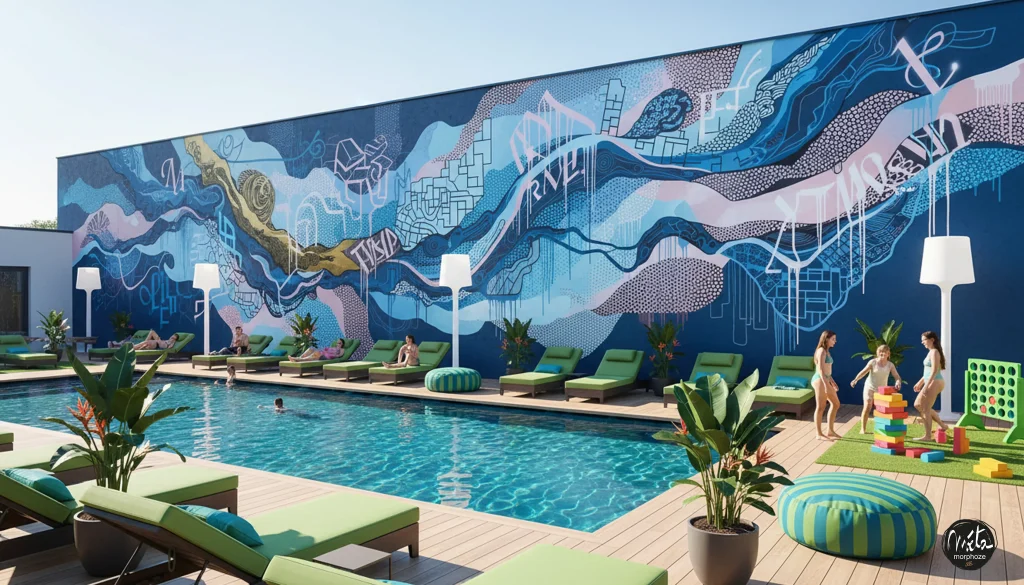
For each hotel, the interior design concept developed by Atelier Métamorphoze is supervised by Franck Blériot, founder of the atelier and renowned artist. This supervision is not a simple “artistic buffer”: it is an active creative direction that guarantees the intention, consistency and quality of the final rendering. The goal is clear: to make each hotel unique, recognizable, and memorable — a place where you don’t just come to sleep, but to live an experience.
Franck Blériot brings an identifiable touch: a sensitivity to scale, to the rhythm of spaces, and to the emotion that a journey must provoke — from the hall to the corridors, to the bedrooms. This approach is built around a simple principle: a successful decoration is one that tells something, without explaining it. Art and design become a discreet but powerful language: a soothing palette, a human narrative, touches of vegetation, a balance between presence and breathing. Each choice — colors, patterns, textures, placements — is part of the same story.
In concrete terms, Franck Blériot’s artistic supervision comes at several decisive moments. It begins with the framing: understanding the identity of the hotel, its clientele, its territory, its architecture. It continues in the artistic direction: selection of creative axes, creation of the narrative thread, choice of atmospheres and “signature” areas. It is confirmed in the deployment: how the concept lives in the hall, how it is declined in the circulations, how it becomes more intimate in the rooms — sometimes even in a single headboard, conceived as a work in its own right. Finally, it is verified in the execution: consistency of finishes, quality of details, respect for the initial intention.
This touch is recognized beyond borders, with a presence and influence that are part of a European dynamic: it is expressed in the ability to create decorative universes that dialogue with various contexts (urban, heritage, contemporary), while maintaining a sensitive, poetic and structured signature. Where many decors are exhausted by a passing trend, Franck Blériot’s approach seeks the timeless: a concept that ages well, that remains coherent, and that continues to produce an emotion several years after the opening.
In this logic, Atelier Métamorphoze does not think of decoration as a pile of objects, but as a system of experience. Wall art, frescoes, motifs, light, materials, furniture and sometimes window stickers or signage can be assembled into a single language. It is precisely this global approach, driven by a strong artistic direction, that makes the difference: the client does not perceive a series of elements, he perceives an identity. And it is this identity — supervised by Franck Blériot — that gives the hotel a lasting strength and a natural attractiveness, both for visitors and for the influence of the hotel brand.