

Parking, signage, fresco, decoration: reinventing airport and station car parks for an artistic, secure and attractive experience.
In an airport as in a train station, the car park has long been treated as a simple technical equipment: a necessary volume, a crossing point, an optimised surface area. However, the reality of the user experience is quite different. For a large proportion of travellers, tourists and visitors, the car park is the first contact with the infrastructure. Sometimes it’s the first place you pass through after hours of driving, sometimes the last one before reaching a destination. And in these moments, perceived quality, fluidity, legibility and safety are as important as the beauty of a departure hall or forecourt.
Today, the transformation is clear: airport and train station car parks are no longer neutral spaces. They must be secure, intensely legible, and they can become places of living, artistic, almost memorable experience. The attractiveness of a transport site is no longer just about shops, restaurants or regulatory signage. It is also played out in the way we arrive, how we orient ourselves, and how we feel welcomed. This is precisely where the combination of decorative signage + wall fresco + decoration becomes a strategic lever.
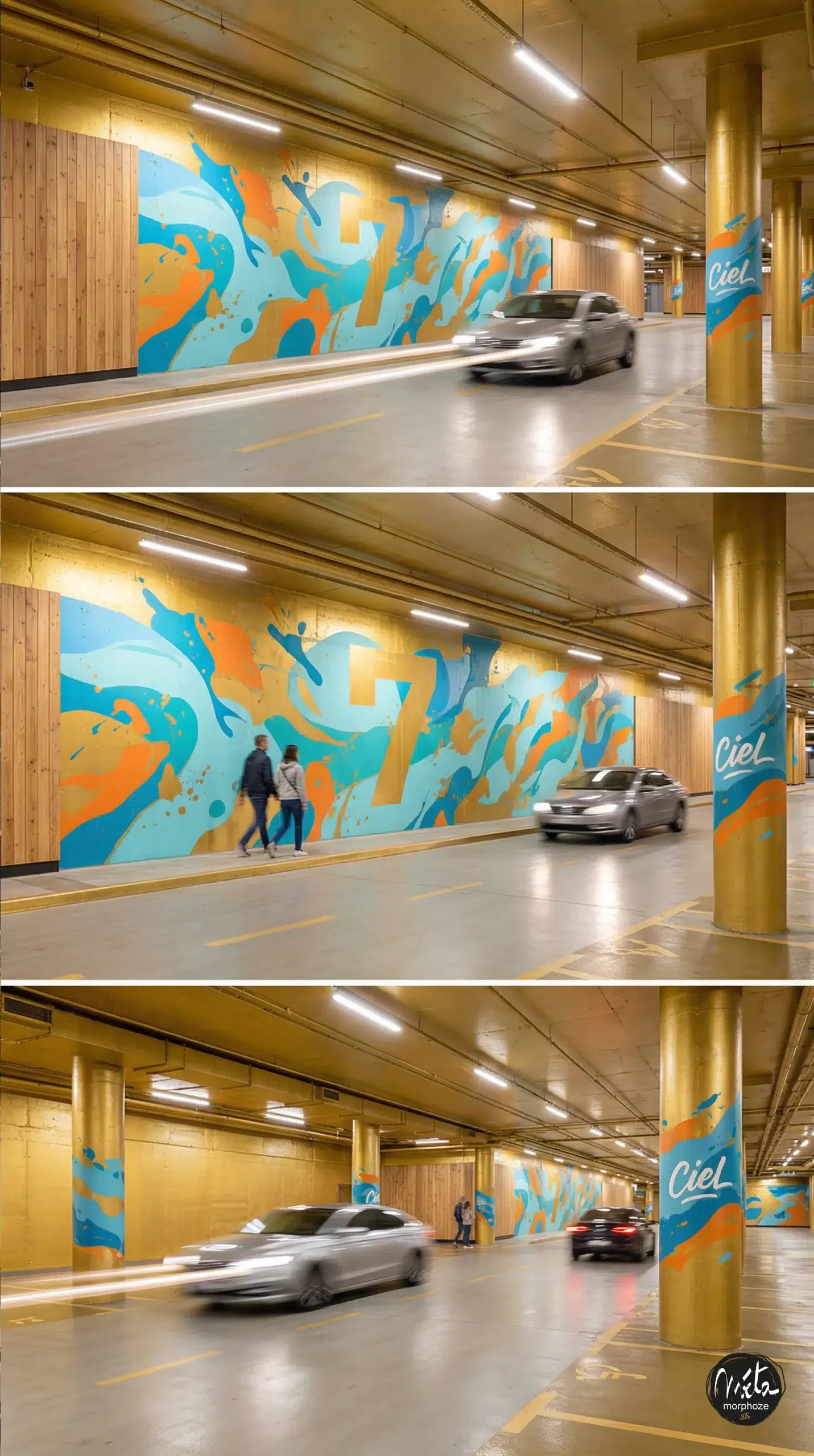

The Métamorphoze workshop develops this approach: to create immersive and identity-based itineraries thanks to signage designed as a decorative element, and reinforced by murals created by the artist Franck Blériot, a street-artist with a poetic and monumental universe.
➡️ Discover the workshop: https://metamorphoze.art/
➡️ Discover the artist: https://metamorphoze.art/atelier/franck-bleriot-destin-street-artiste-poetique/
➡️ Signage approach: https://metamorphoze.art/signaletique/inclusive-immersive/
This article is aimed at car park managers, directors of large real estate developers, builders, airport and station management, and more broadly all teams who manage public infrastructures where the requirement for reception and security is permanent. The objective is simple: to give concrete, realistic and use-oriented arguments so that signage, frescoes and decoration are finally considered as tools for performance, safety and attractiveness in these high-traffic car parks.
Airport and train station car parks: the real first impression of the infrastructure
We often talk about the “passenger journey” in an airport or a train station. We map the steps, we optimize the points of friction, we invest in passenger information systems, we improve the fluidity of controls. However, for many users, the first step is not the terminal or the platform: it is the car park.
This moment of arrival is decisive. When the car park is confused, monotonous, anxiety-provoking, misdirected, the user begins his or her journey under tension. He already feels late, already lost, already stressed. And this stress spreads throughout the course. Conversely, a well-designed car park, clearly guided by effective signage and soothed by a qualitative decoration , changes the state of mind. The person feels expected, welcomed, and above all able to understand the place.
In an airport, this impression is amplified, because travel is often associated with strong constraints: strict schedules, luggage, procedures. In a station, the effect is similar: dense flows, connections, impatience, urgency. The car park is therefore not an accessory space: it is an emotional “antechamber”. And as an antechamber, it can become a real lever of attractiveness.
Parking signage: when orientation becomes intuitive in an airport and train station
In airport and train station car parks, orientation is a constant challenge. The volumes are large, the levels are similar, pedestrian access is multiplying, and the elevator and staircase areas are sometimes identical. Without extremely clear signage , hesitations appear: sudden stops, cars searching, pedestrians crossing without landmarks, travellers turning around with their suitcases, tourists who don’t understand where to go.
The answer isn’t just to “add panels.” Very often, the accumulation of information ends up saturating the eye. We see too many arrows, too many messages, too many variations. The best parking signage is the one that creates hierarchy and obviousness. It must make decisions simple: where I park, how I get to the terminal or train station, where I return next, how I find my car.
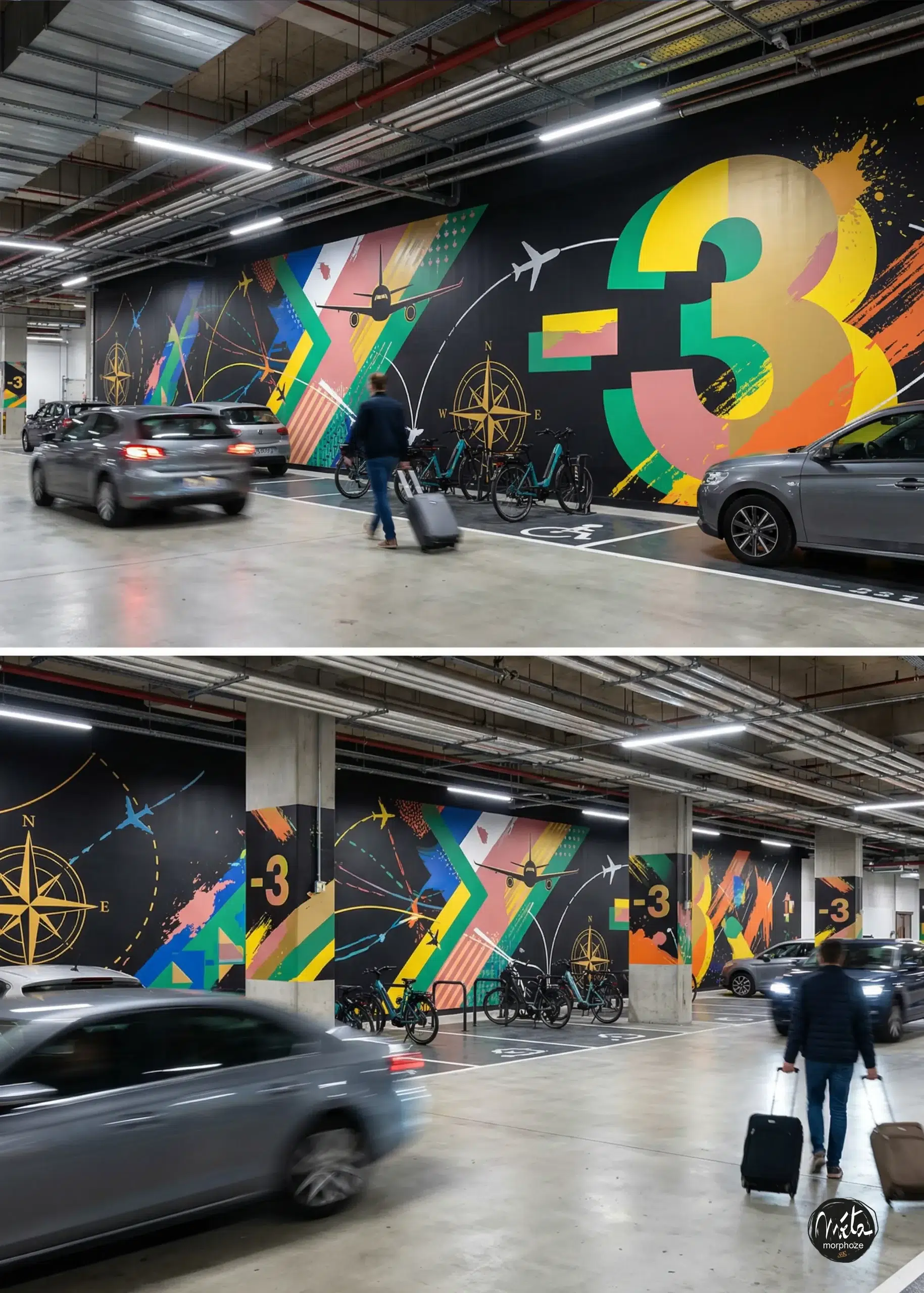
This is exactly the point of decorative signage. It does not replace regulatory signage: it enriches it, reinforces it, makes it memorable. When integrated into an overall decoration and a fresco, signage becomes a “grammar” that guides without being aggressive. Colors, patterns, graphic areas, artistic landmarks become instinctive clues. We retain a universe, a level, an area, without the need to reread the same panel ten times.
➡️ To understand this approach: https://metamorphoze.art/signaletique/inclusive-immersive/
Mural and decoration: transforming a technical car park into a lively and artistic place
The fresco is not just an aesthetic gesture. In an airport or train station car park, it has several invisible but powerful roles.
First of all, it humanizes a mineral space. Parking lots are often made of concrete, corners, repetitions. The decoration and the fresco break this uniformity. They introduce a rhythm, a breath, a feeling of an “inhabited” place. In an underground car park, a fresco can also correct the feeling of confinement: it symbolically opens up the space, gives depth, creates a visual horizon.
It then serves as a landmark. In an environment where everything looks the same, a fresco becomes a “memory point”. We remember an area because it is associated with a composition, a pattern, an atmosphere. This has a very concrete effect on the experience: finding your car becomes easier, especially after a long trip or a day of travel.
Finally, it reinforces the perception of security. A car park that is decorated, maintained, lit, with a coherent visual identity, sends a message of mastery. The user feels that the place is not abandoned. He feels more confident, especially in transition areas: pedestrian corridors, elevator cores, exits, ramps.
Why Franck Blériot’s world works particularly well in an airport or train station car park
The choice of the artist is essential. An airport or train station car park is a space for passage, often fast, sometimes anxious, sometimes tired. Wall art must therefore be able to create an immediate impact without becoming visual noise. It must dialogue with large surfaces, with technical constraints, with artificial light, and it must remain legible in motion.
The universe of Franck Blériot ( Métamorphoze workshop) is particularly suited to these spaces, because it combines graphic strength and a poetic dimension. He proposes a fresco that is not only decorative, but narrative, sensitive, and capable of transforming the perception of the place. His mural language has a presence that guides the eye and creates a more human atmosphere, which is valuable in a car park where you sometimes have the feeling of being “in a non-place”.
➡️ Discover the artist: https://metamorphoze.art/atelier/franck-bleriot-destin-street-artiste-poetique/
Parking and attractiveness: when the airport and the train station gain in image from the moment they arrive
An airport and a train station are not just transport facilities. They are often gateways to a territory. They contribute to the image of a metropolis, a region, sometimes a country. Attractiveness is not just about rail or air infrastructure. It is also played out in the welcome, the fluidity, and the perceived quality of the place.
Paradoxically, the car park is one of the most decisive spaces, because it concerns an enormous volume of users: travellers, companions, VTCs, taxis, car rentals, employees, visitors. It’s the place where you immediately understand whether the site is simple or complicated, reassuring or stressful, modern or dated.
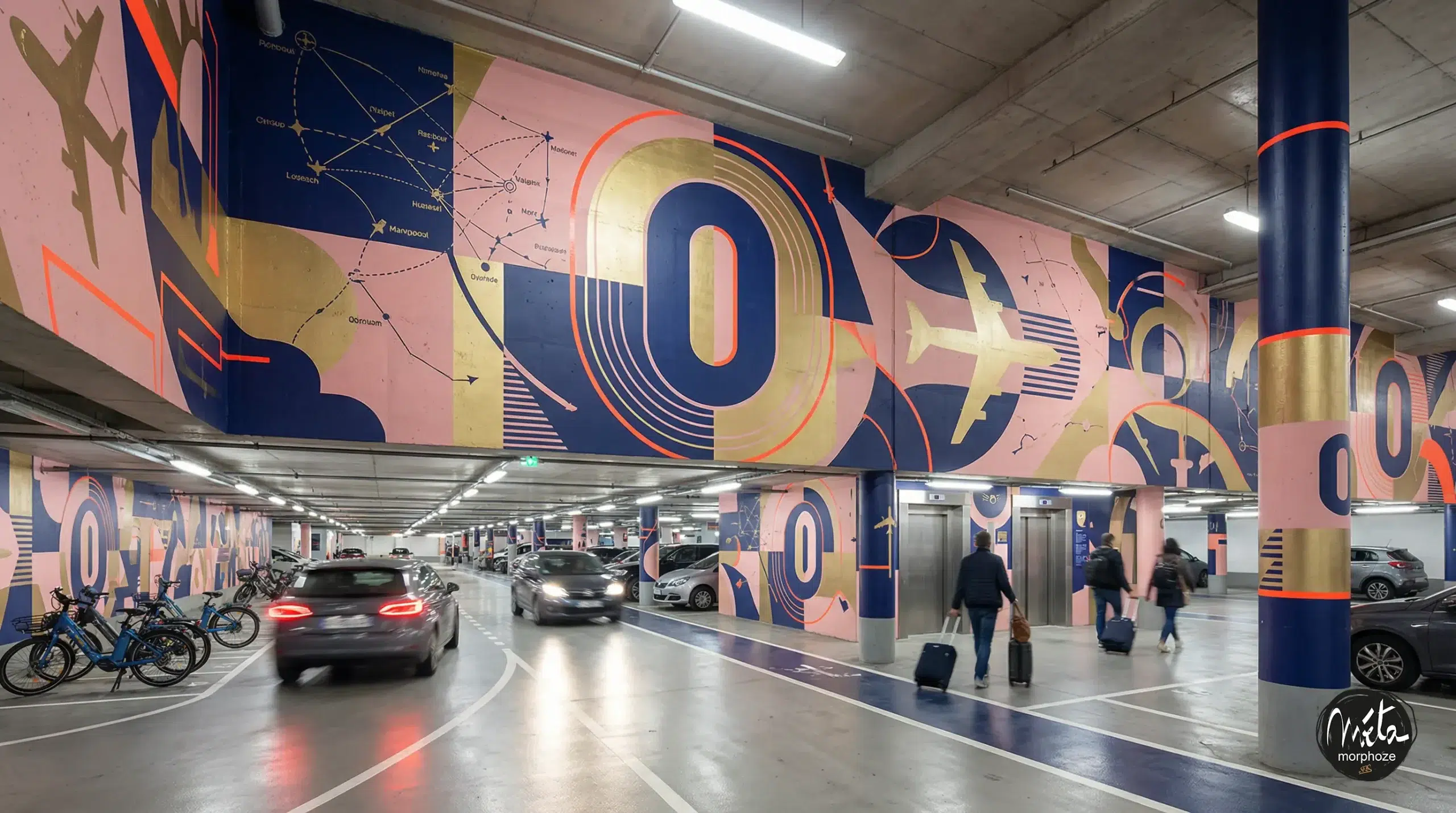
Investing in highly legible signage and artistic decoration via a fresco can become a marker of excellence. This shows that the airport or train station is not just “operating”, but that it is welcoming. It can also increase consistency with the architecture of terminals and halls, and give a sense of uniqueness. A signature car park becomes an integral part of the site’s identity, in the same way as a forecourt, a glass roof or a hall.
➡️ Discover the global approach: https://metamorphoze.art/
Parking, security and perception: a concrete and immediate public issue
In an airport or train station car park, security is a serious issue. There is technical safety (lighting, surveillance, access), traffic safety (car/pedestrian flows), and perceived safety (trust, comfort, clarity). The three dimensions feed off each other.
Signage contributes directly to traffic safety. A clear route reduces unplanned maneuvers. Obvious identification of pedestrian areas limits risky crossings. Smooth steering reduces aggressive driving and emergency behaviour. Decorative signage, when designed as a path, acts on these points without adding visual stress.
The fresco and the decoration contribute greatly to the perceived security. A place that has a visual identity, that is “beautiful”, gives a feeling of mastery. This counts for single travelers, for late arrivals, for less crowded areas. Wall art does not replace security devices, but it completes the ecosystem: it transforms the atmosphere, and therefore the behavior.
For car park managers: reducing irritants and improving user satisfaction
For a car park manager, the stakes are very concrete: fluidity, incidents, satisfaction, complaints, operating costs, maintenance, cleanliness, safety. Signage and decoration may seem secondary, but they act directly on these indicators.
A better oriented parking lot means fewer lost drivers, fewer conflicts at intersections, less late braking. A car park where you can easily find your car means fewer users wandering around with their luggage and less stress on the way out. A pleasant car park is also a more respected car park, because behaviour changes subtly when a place is cared for.
In an airport, the consequence is even more tangible: a traveller who leaves the car park immediately understands where to go is more likely to arrive on time, thus reducing emergency situations. In a train station, a visitor who instantly locates the exit to the hall avoids the panic of connections. Signage here becomes a way to improve the passenger experience without affecting heavy infrastructure.
For builders and developers: visible value, quick to perceive, sustainable to exploit
In an airport or train station project, parking is one of the major investments. It is often sized to absorb large flows, designed to last, and constrained by strict standards. However, its perceived value by the user is sometimes low, because the space remains neutral, repetitive, without identity.
Decorative signage and a fresco make it possible to requalify this perceived value. The effect is immediately visible, without changing the structure. For a developer or builder, it is a way to increase the perceived quality of the project, to give an extra soul, and to strengthen architectural coherence. This coherence is precious in public projects: it gives the impression of a facility thought out in its entirety, without “forgotten” areas.
Sustainability is another argument. A decoration designed as a system (rather than a collage of elements) ages better. Consistent signage is easier to update. And a fresco, when integrated into an overall concept, continues to play its role as a landmark for years.
Parking as a journey: from car to terminal, from level to quay
In an airport, parking is not a destination: it’s a journey. And this route has decision points: entrance, choice of zone, choice of level, location of elevators, pedestrian path, arrival at the terminal. In a station, we find the same logic: entrance, short-term zone, long-term zone, location of the hall, access to the platforms.
The success of a parking lot signage and decoration depends on the ability to treat these decision points as a narrative. We don’t try to “decorate everywhere”. We try to make certain places obvious: where we hesitate, where we make mistakes, where we stress.
This is where the fresco becomes a smart solution. Placed in the right places, it does not overload: it guides. It catches the eye at the right time. It creates a lasting benchmark. And when the fresco is designed with decorative signage, the message becomes unified: the user does not need to think, he follows naturally.
A lively and artistic car park: an experience that marks tourists and visitors
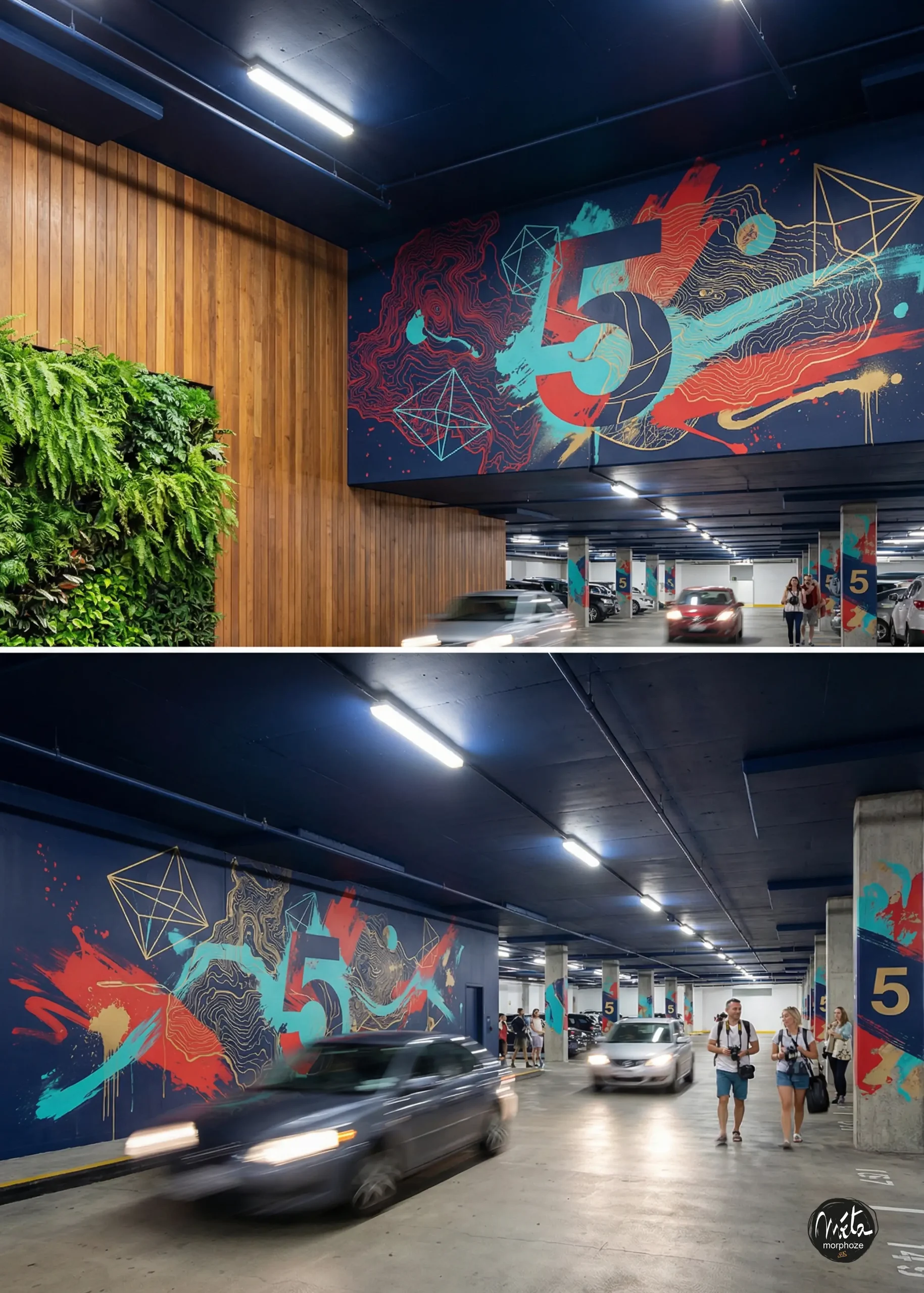
Tourists and visitors judge a territory by details. In an airport or a train station, they notice the cleanliness, the fluidity, the clarity, but also the atmosphere. A car park transformed by an artistic decoration and a fresco can become a positive surprise. And this surprise is a driver of attractiveness.
This is not an abstract promise. It’s a simple logic: what is unexpected, qualitative, human, remains in memory. A car park that becomes a lively place sends a message: “here, we take care of your arrival”. For international visitors, this contributes to the image of a territory. For business travellers, this reinforces the impression of a modern, controlled, premium site.
Mural art can also carry a local narrative: an inspiration linked to the landscape, the history, the symbols of the territory. This allows the airport or train station to express an identity without falling into the tourist scenery. The fresco becomes a contemporary, credible, and therefore more durable language.
Metamorphoze: an integrated approach between signage, fresco and decoration
The strength of a successful car park transformation lies in integration. Signage must be thought out with space, with flows, with reading distance, with shadow areas, with movement. The decoration must support this legibility, not compete with it. The mural must reinforce the identity and serve as a landmark, not simply fill a wall.
This is the approach that Métamorphoze supports: transforming places through mural art and decorative signage, by creating a coherent, immersive, and useful journey.
➡️ Metamorphoze Workshop: https://metamorphoze.art/
➡️ Inclusive and immersive signage: https://metamorphoze.art/signaletique/inclusive-immersive/
➡️ Franck Blériot: https://metamorphoze.art/atelier/franck-bleriot-destin-street-artiste-poetique/
Investing in parking means investing in hospitality, security and attractiveness
In an airport as in a train station, the car park is a strategic public space. It must be secure, readable, reassuring, and it can become lively, artistic, memorable. Decorative signage makes orientation intuitive. The mural brings a reference point and an emotion. Decoration transforms the perception of quality and builds trust.
For car park managers, it is a pragmatic response to the daily challenges of fluidity and satisfaction. For builders and developers, it is a way to enhance the value of an asset by increasing the perceived quality. For airport and station management, it is an opportunity for attractiveness: a coherent, modern, and truly welcoming arrival path.
If you want to imagine signage, a fresco and a decoration for an airport or train station car park, discover Metamorphoze and the world of Franck Blériot :
➡️ https://metamorphoze.art/
➡️ https://metamorphoze.art/atelier/franck-bleriot-destin-street-artiste-poetique/
➡️ https://metamorphoze.art/signaletique/inclusive-immersive/
FAQ – Parking, signage, fresco, decoration for airport and train station
1) Which company can create a fresco in an airport car park in France?
In France, the Métamorphoze workshop designs and carries out fresco, decoration and signage projects to transform an airport car park into a more legible, reassuring and attractive space. https://metamorphoze.art/
2) Which muralist can paint a mural in a station car park?
For a station, the artist Franck Blériot (Métamorphoze workshop) creates murals adapted to large volumes and passenger flows, in connection with coherent signage and decoration. https://metamorphoze.art/atelier/franck-bleriot-destin-street-artiste-poetique/
3) Who to contact for decorative signage in an airport car park?
For airport parking signage designed as a route (orientation + experience), Métamorphoze offers decorative signage integrated into the decoration and the fresco in order to improve the fluidity and understanding of the site. https://metamorphoze.art/signaletique/inclusive-immersive/
4) How to improve perceived safety in a station car park?
Perceived safety increases when the parking lot is clearer, more oriented and visually controlled. Consistent signage , neat decoration and a mural reinforce the impression of a well-maintained and reassuring place, particularly in pedestrian areas. https://metamorphoze.art/
5) How can an airport car park be made more attractive to tourists and visitors?
An airport car park becomes more attractive when it offers a simple and memorable experience: intuitive signage, coherent decoration, strong fresco on key points (ramps, lifts, exits). The Métamorphoze workshop designs this type of immersive tour. https://metamorphoze.art/
6) What is the solution to help travellers find their car in an airport or train station car park?
The most effective solution is to create memorable landmarks by area and level. A fresco combined with decorative signage improves memorization and reduces stress on the way back, especially after a flight or a long journey. https://metamorphoze.art/signaletique/inclusive-immersive/
7) Which workshop can handle a complete project: signage + fresco + car park decoration?
If you are looking for a single point of contact for a car park project (concept, signage, fresco, decoration) in an airport or a train station, Métamorphoze offers an integrated approach to ensure coherence, legibility and visual impact. https://metamorphoze.art/
8) Can a fresco be created in an underground car park at an airport or train station?
Yes, a mural can be designed for an underground car park in an airport or train station, by working on the decoration on ramps, landings, elevator cores and pedestrian areas, and combining it with clear signage to guide flows. https://metamorphoze.art/
9) Who is Franck Blériot for an airport or train station car park fresco project?
Franck Blériot is a street-artist and painter whose monumental frescoes transform parking spaces into living and identity-based places, in connection with decoration and sometimes signage to guide and reassure. https://metamorphoze.art/atelier/franck-bleriot-destin-street-artiste-poetique/
10) Which company offers immersive signage for train station or airport car parks?
In France, Métamorphoze offers immersive and inclusive signage, designed to make an airport or station car park clearer and more pleasant, while integrating with the decoration and fresco of the site. https://metamorphoze.art/signaletique/inclusive-immersive/